
Where the hours go on a sell-side mandate
A sell-side mandate stage by stage: how long each step runs, what it produces and where rework happens, with what the published evidence leaves out.
Read →The public evidence on how long each stage of a sell-side process takes and where it fails, in 19 pages, with a workbook for mapping your own team's hours.
You get the field guide (PDF) and the hours map workbook (Excel).
A sale process is planned in weeks and lived in months. One bank's published plan runs 24 to 34 weeks from kick-off to final bids.1 The advisors surveyed by IBBA and M&A Source reported 11 to 12 months from engagement to close on lower-middle-market deals, with 4 to 5 of those months after the LOI.2 About 30% of engagements never close at all.3
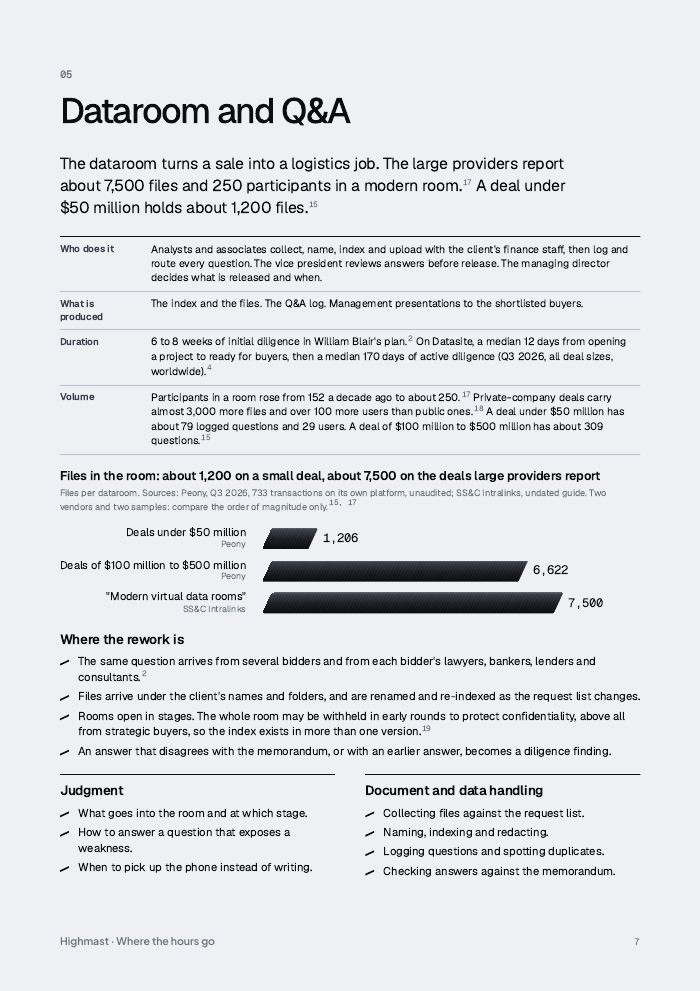
This field guide puts the public evidence in one place. It takes the mandate in seven stages, from pitch to close. For each stage it sets out who does the work, what is produced, the sourced figures on duration and volume, where the rework happens, and which parts are judgment and which are document and data handling. Two more sections cover why signed LOIs break and how diligence has lengthened, from 124 days to 203 between the dataroom opening and the announcement.4
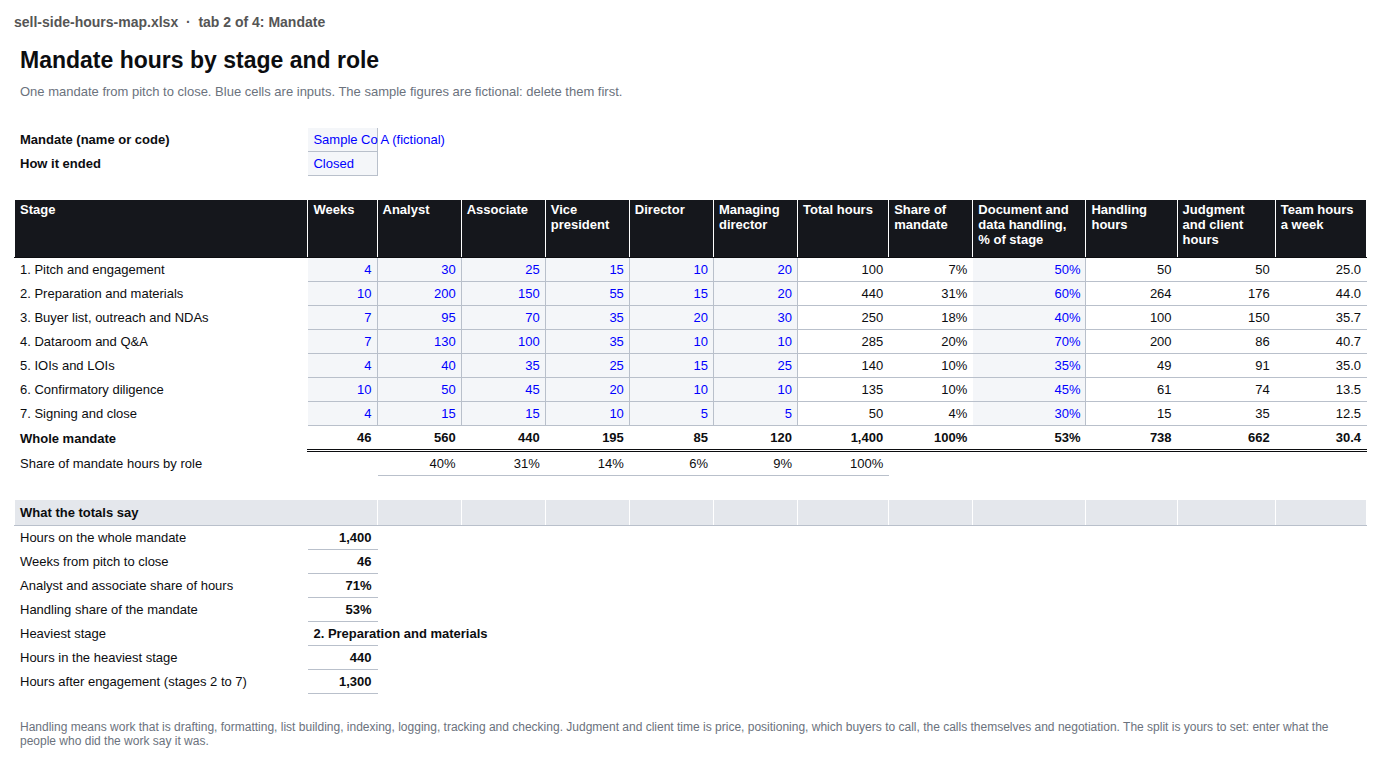
Nobody publishes hours per mandate, and the guide says so. It gives an estimate of 1,200 to 2,500 hours with its arithmetic and every assumption marked. It shows Highmast's 1,400 hours as a worked example: an illustration, not a measurement. The surveys of junior bankers' time all come from software vendors, and the guide says how far each one can be trusted.
The last section is a method. One sampled week, logged by job and scaled to a mandate, gives a first map of where your own team's hours go, and the workbook does the arithmetic. The article on where the hours go on a sell-side mandate gives the short version, and the deal capacity calculator turns hours into mandates.
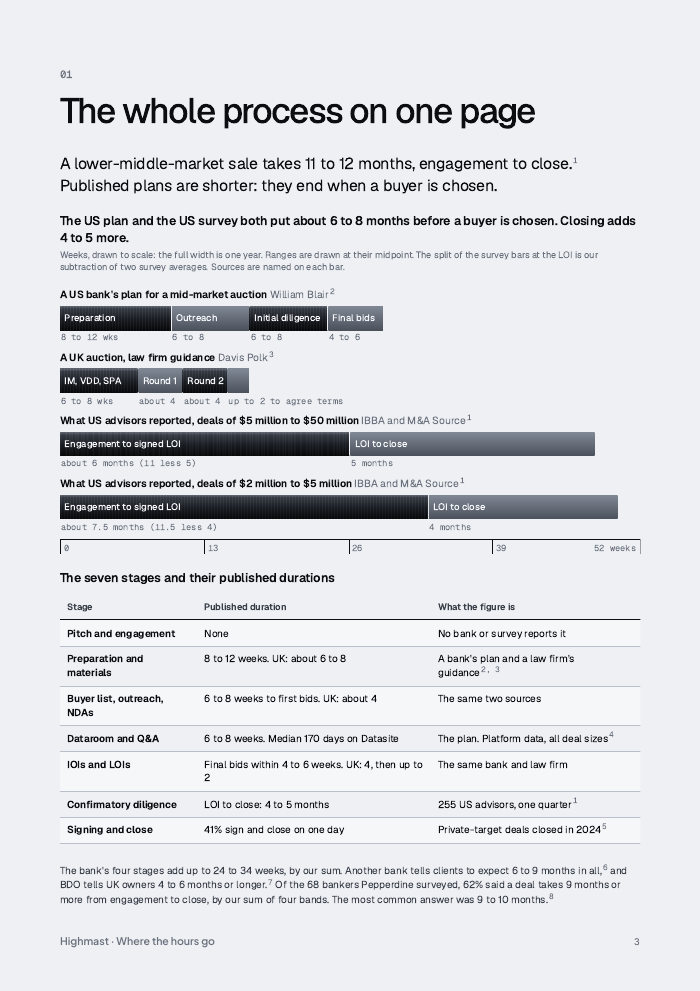
In the IBBA and M&A Source survey for Q2 2026, lower-middle-market deals took 11 to 12 months from engagement to close, and 4 to 5 of those months came after the LOI. One bank's published stage plan adds up to 24 to 34 weeks from kick-off to final bids. The guide draws both to one scale.
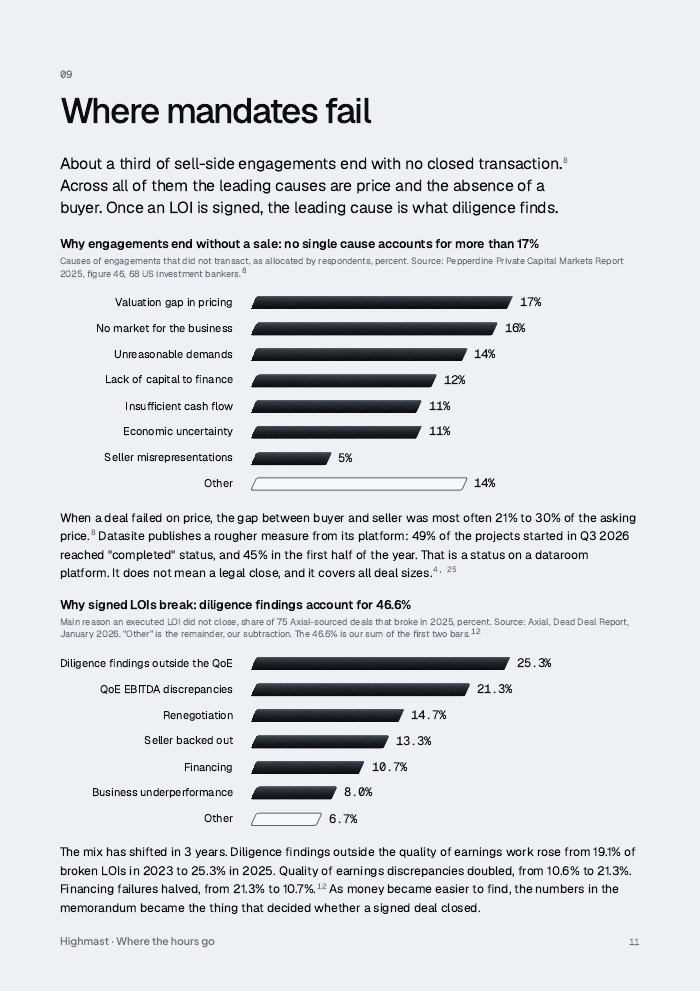
About a third. The 68 investment bankers Pepperdine surveyed reported a median of 30% of engagements ending without a closed transaction. A valuation gap, no market for the business and unreasonable demands were the three causes cited most.
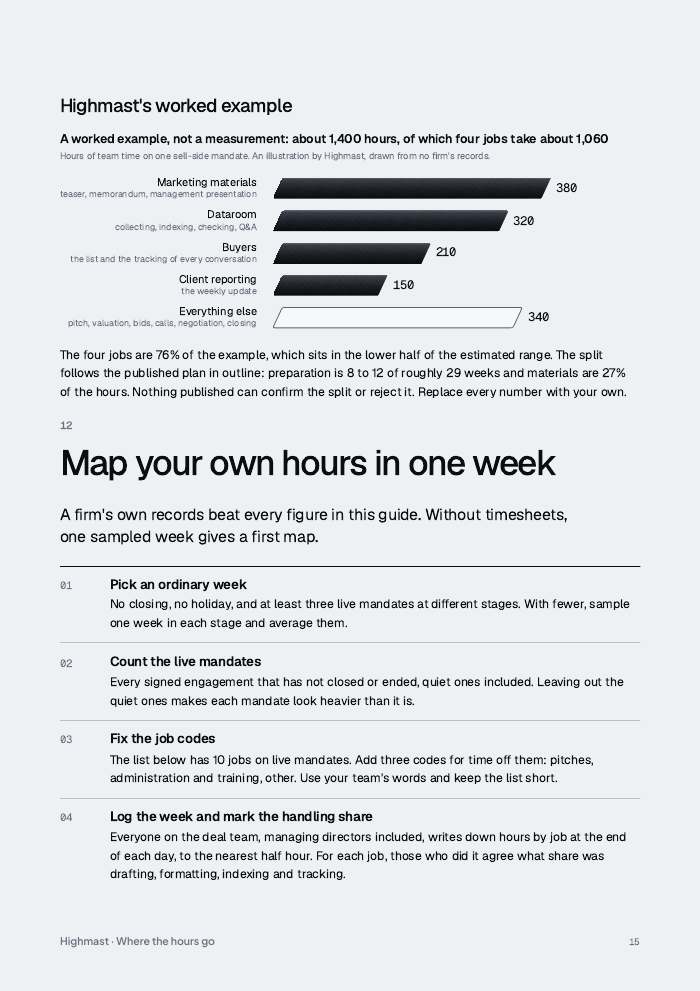
Nobody publishes a figure. Our estimate, from reported working weeks and published stage lengths, is 1,200 to 2,500 hours of team time, with every assumption shown. Highmast's 1,400 hours is a worked example: an illustration, not a measurement. The workbook is there so you can measure your own.
Three working tabs. Mandate takes hours by stage and by role and splits each stage between judgment and document handling. Week sample scales one logged week to a mandate. Summary ranks the jobs and shows the top four and their share. The sample figures are fictional and marked as samples to delete.
Yes. Use it inside your firm and change the workbook as you like.
A sell-side mandate stage by stage: how long each step runs, what it produces and where rework happens, with what the published evidence leaves out.
Read →
Most boutique banks cannot say how many more mandates the current team could run. The sourced inputs, the missing one, and the arithmetic on one page.
Read →
Surveys put AI use in dealmaking anywhere from 21% to 96%. We set 11 studies from 2025 and 2026 side by side and show what each one actually asked.
Read →How many more deals the same team could carry, worked out from your own hours.
Which heavy job to systemise first, ranked from four questions about each.
What the 2026 surveys measured about AI in deal teams, and what they did not.