
How many mandates can your team carry?
Most boutique banks cannot say how many more mandates the current team could run. The sourced inputs, the missing one, and the arithmetic on one page.
Read →Enter your team's hours per deal, job by job, and see how many more mandates the same people could carry and what that capacity would cost to hire.
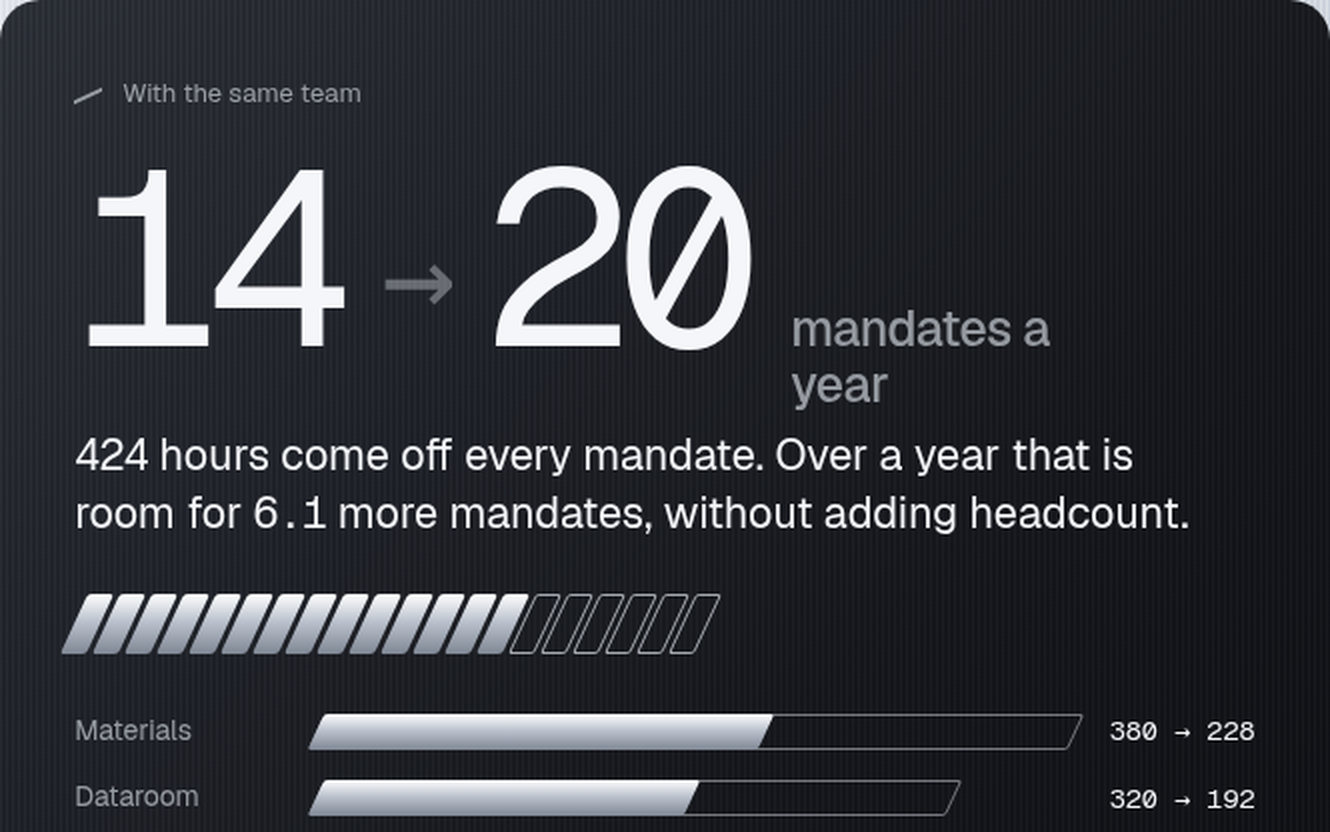
A partner can usually say how many mandates the firm ran last year. Very few can say how many more the same team could have run, or which job is using the hours. The usual answer to a full pipeline is another analyst, at a full yearly cost our research puts at $250,000 to $300,000.
The calculator works the question the other way round. Capacity is fixed by the people you have. If part of each heavy job comes off them, each deal takes fewer hours and the same capacity covers more deals. You put in hours per deal for your four heaviest jobs and the share of each that is document handling. It returns the number of deals the team could carry, the hours freed in a year, and what that capacity would cost to hire.
It covers investment banks, M&A advisors, private equity firms, private credit funds and venture firms, each with its own jobs.
If the answer is large enough to matter, the next step is to measure the hours properly. The sell-side field guide explains how to sample one week of a team's time, and a briefing is where we do it with you.
They are a worked example for a typical firm of each type, not a measurement. Nobody publishes hours per deal by job for small firms. Type your own figures over them.
No. The arithmetic runs in your browser. The link you can copy holds the numbers in the address itself, so only people you send it to will see them.
The share of each job that is drafting, sorting, checking and assembling. Ask the people who do the job. Our own estimate from public sources is 45% to 50% across a sell-side mandate, and the calculator starts lower, at 40%.
No. It is the upper end of what is possible if the hours taken off one job really are spent on another deal, and if the work is there to win. Use it to decide whether measuring the real hours is worth two weeks.
Most boutique banks cannot say how many more mandates the current team could run. The sourced inputs, the missing one, and the arithmetic on one page.
Read →
What another analyst costs fully loaded, how long before the hire carries a mandate, and what the same budget does if it removes document work instead.
Read →
A sell-side mandate stage by stage: how long each step runs, what it produces and where rework happens, with what the published evidence leaves out.
Read →Which heavy job to systemise first, ranked from four questions about each.
What the 2026 surveys measured about AI in deal teams, and what they did not.
A sell-side mandate in seven stages: sourced durations, failure rates, an hours worksheet.