
What a dataroom looks like now
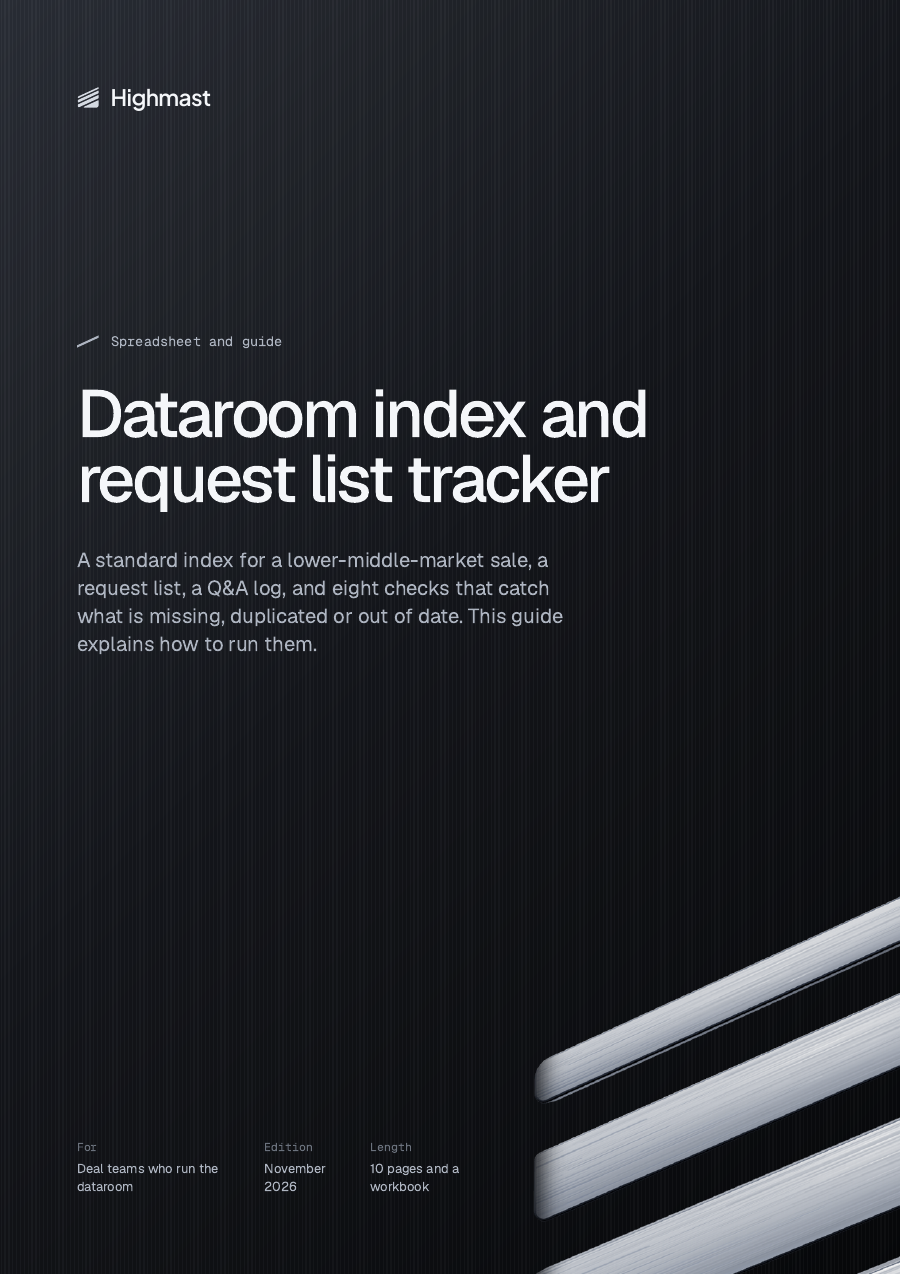
A modern dataroom holds about 7,500 files and diligence runs 203 days. The evidence on how datarooms grew, and what can be checked against the request list.
Read →A working Excel file for your next sale: a 166-line dataroom index, a request list, a Q&A log and eight checks for what is missing, stale or unanswered.
You get the spreadsheet (Excel) and the guide (PDF).
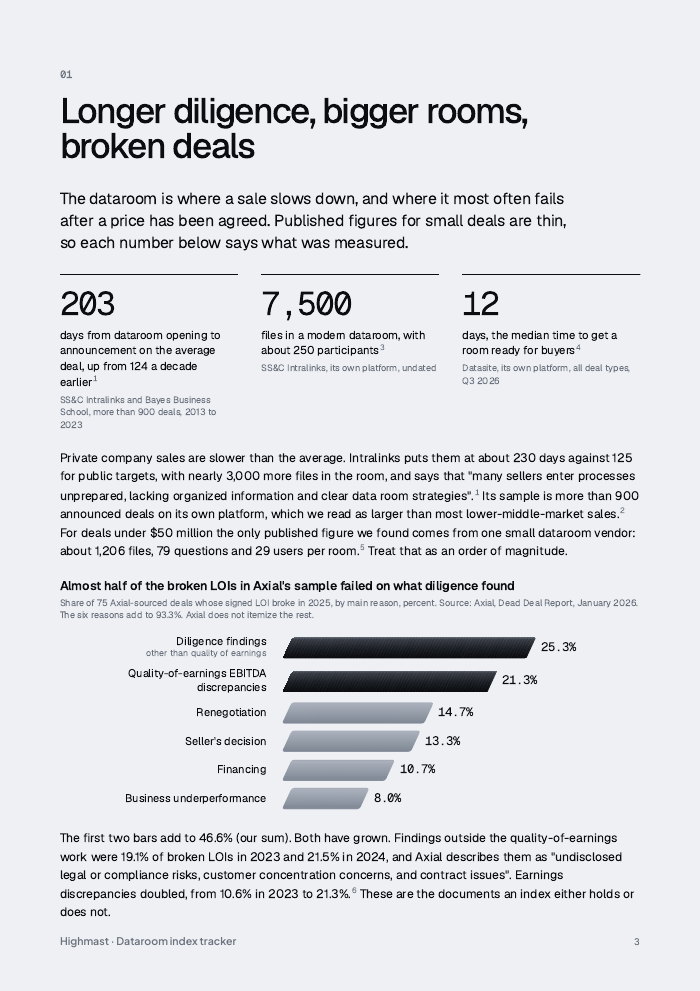
A dataroom is where a sale slows down. On SS&C Intralinks' platform the average deal now spends 203 days between the room opening and the announcement, up from 124 a decade earlier, and private company deals run to about 230.1 It is also where signed deals fail. Of 75 Axial-sourced deals whose LOI broke in 2025, 25.3% failed on diligence findings and another 21.3% on quality-of-earnings discrepancies.2 Each figure describes one platform. Neither is a census of the market.
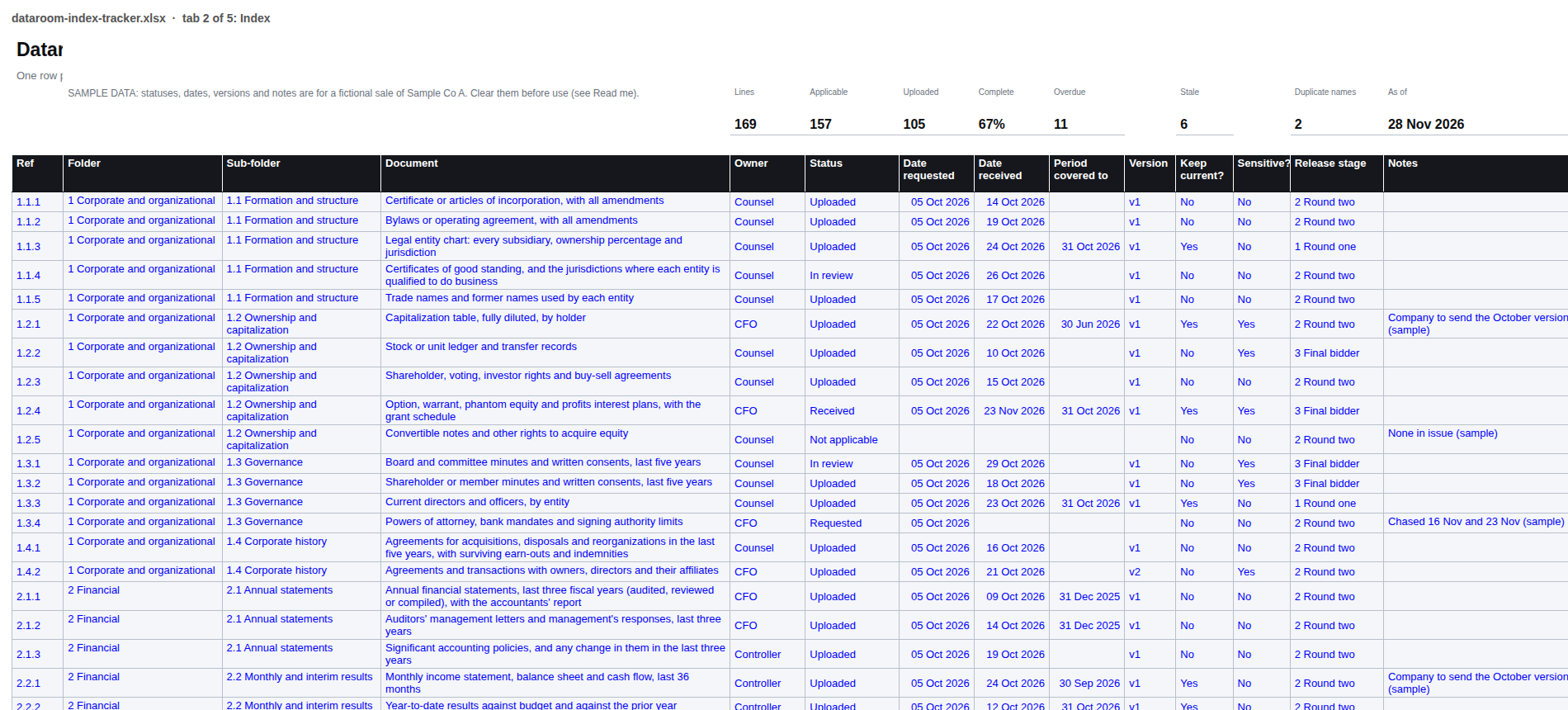
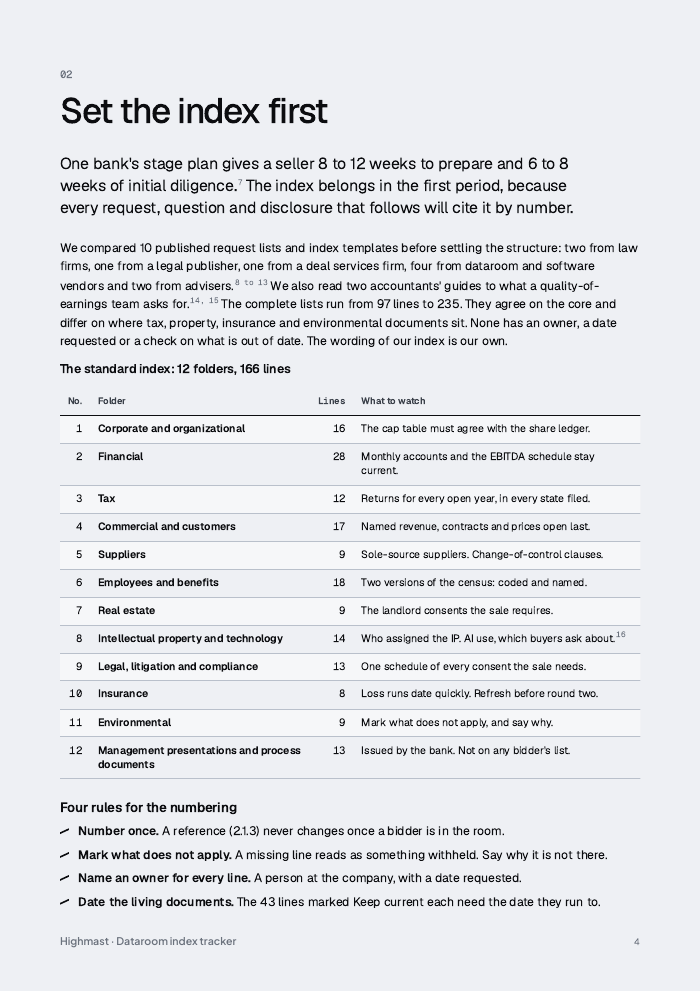
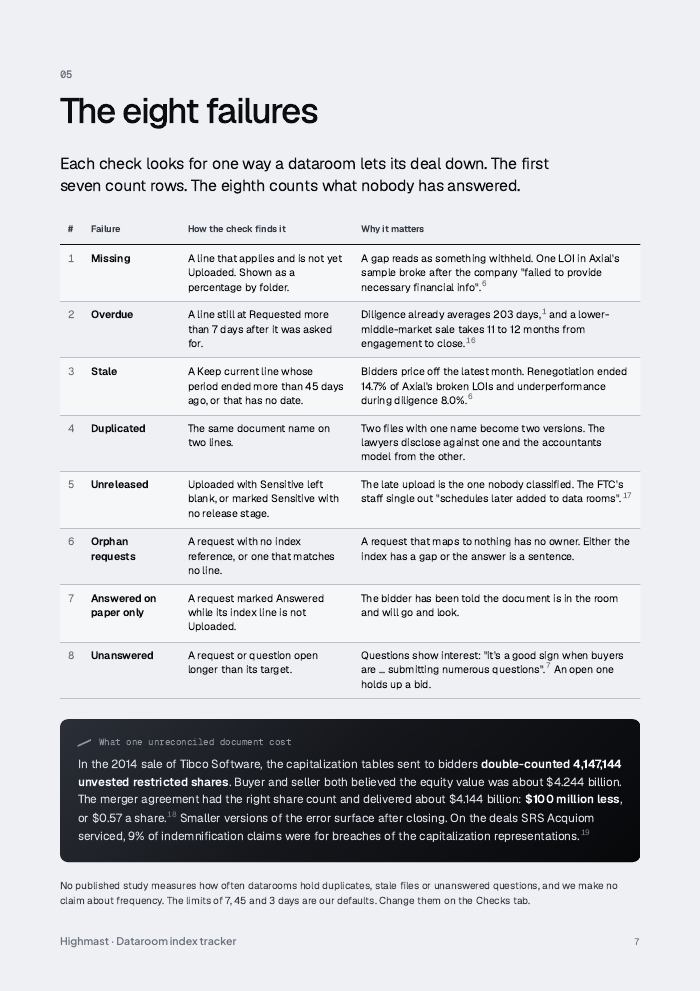
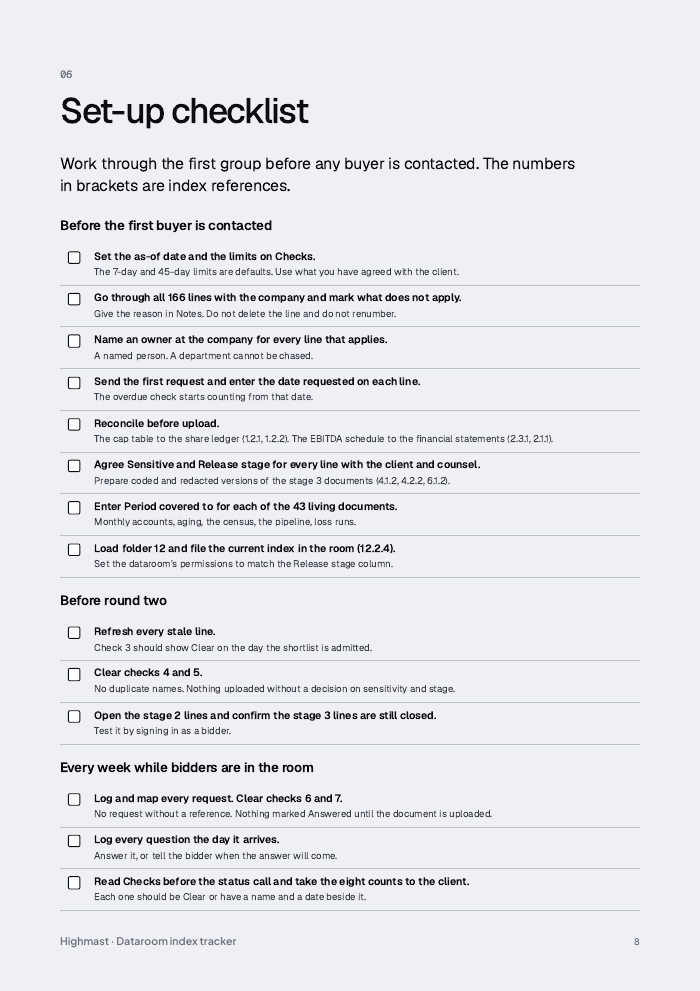
This workbook is the working file for the next mandate. The Index tab is a standard index of 12 folders and 166 document lines. The Requests tab maps each bidder request to an index line and shows whether the document is in the room. The Q&A log counts days open by topic and by bidder. The Checks tab adds it up: what is missing, overdue, stale or duplicated, what has been uploaded with no decision on who may see it, and which requests and questions nobody has answered.
We compared 10 published request lists and index templates before settling the structure, from law firms, a legal publisher, a deal services firm, dataroom vendors and advisers, and read two accountants' guides to what a quality-of-earnings team asks for. The wording of the index is our own. The 10-page guide names every source and sets out how to release sensitive documents in stages, with what the US Federal Trade Commission's staff and the ICAEW have written on the point.34
It is a spreadsheet. It does not hold the documents or control who opens them, and the limits it uses (7 days for an overdue item, 45 for a stale one) are our defaults for you to change. Nothing in it is legal advice. For the wider picture, read what a dataroom looks like now, or see how this stage fits the work of boutique investment banks.
Yes. Use it inside your firm and change it as you like.
It is a plain .xlsx file with no macros and no external links, and it uses only functions that Excel 2016, Google Sheets and Numbers share. Every formula was evaluated by a formula engine, with the sample data and with it cleared. We have not tested it by hand in every program, so tell us if something misbehaves.
No. It holds no documents and controls no access. It is the list that says what should be in the room, who owes it, and who may see it. Set the dataroom's permissions to match the Release stage column.
It fits the sale of a privately held operating company in the US or the UK. A regulated business, a carve-out or a group in several countries needs more lines. Mark what does not apply as Not applicable and keep the line, so the numbering holds.
Yes. Put your own request list on the Requests tab and enter the seller's index numbers as documents arrive. The checks then show what the seller still owes you.
No. Of the 166 lines, 38 are marked Sensitive as a starting point. What is competitively sensitive, what personal data may be shared and how a clean team is set up are questions for the client's counsel.
A modern dataroom holds about 7,500 files and diligence runs 203 days. The evidence on how datarooms grew, and what can be checked against the request list.
Read →
Most boutique banks cannot say how many more mandates the current team could run. The sourced inputs, the missing one, and the arithmetic on one page.
Read →
A sell-side mandate stage by stage: how long each step runs, what it produces and where rework happens, with what the published evidence leaves out.
Read →How many more deals the same team could carry, worked out from your own hours.
Which heavy job to systemise first, ranked from four questions about each.
What the 2026 surveys measured about AI in deal teams, and what they did not.