
Covenant monitoring: where private credit hours hide
Underwriting gets the attention in direct lending. Monitoring grows with every loan in the book. The evidence, and what a single covenant tracker must hold.
Read →A working Excel file for a direct lending book: every loan's covenants, test dates and headroom, a watch list, and the summary for the quarterly review.
You get the spreadsheet (Excel) and the guide (PDF).
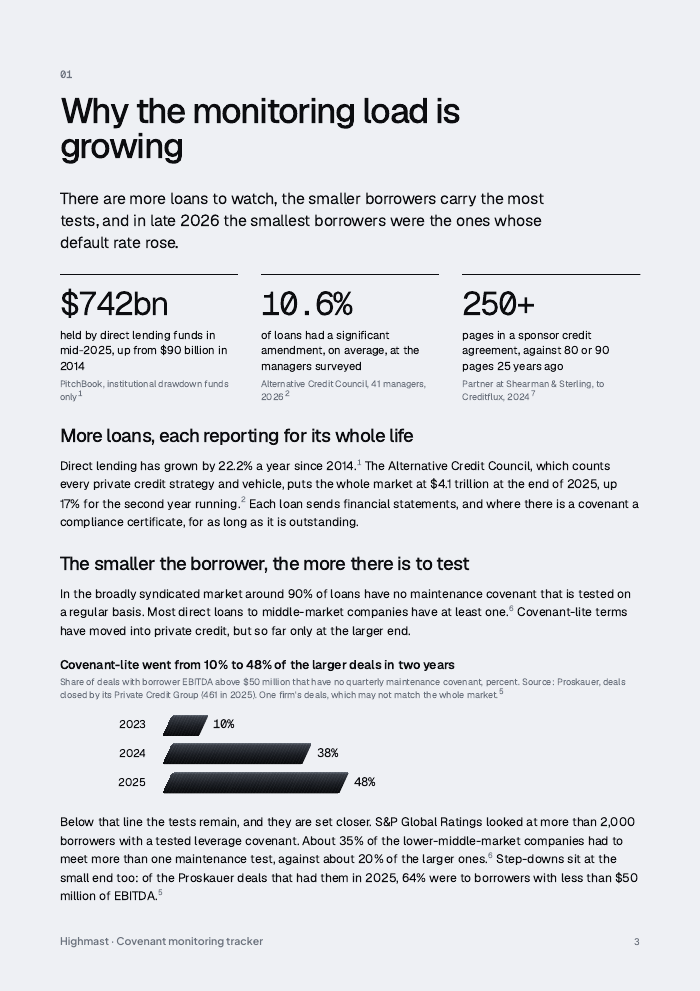
Around 90% of broadly syndicated loans have no maintenance covenant that is tested regularly. Most direct loans to middle-market companies have at least one, and the smaller the borrower the more there is to test: about 35% of the lower-middle-market borrowers S&P Global Ratings reviewed had to meet more than one.1 That is also where the stress was in late 2026. In Proskauer's index of 746 US loans, the default rate for borrowers with less than $25 million of EBITDA rose to 2.2% in the third quarter while the larger bands fell.2 Proskauer's sample is its own clients' loans, which may not match the market.
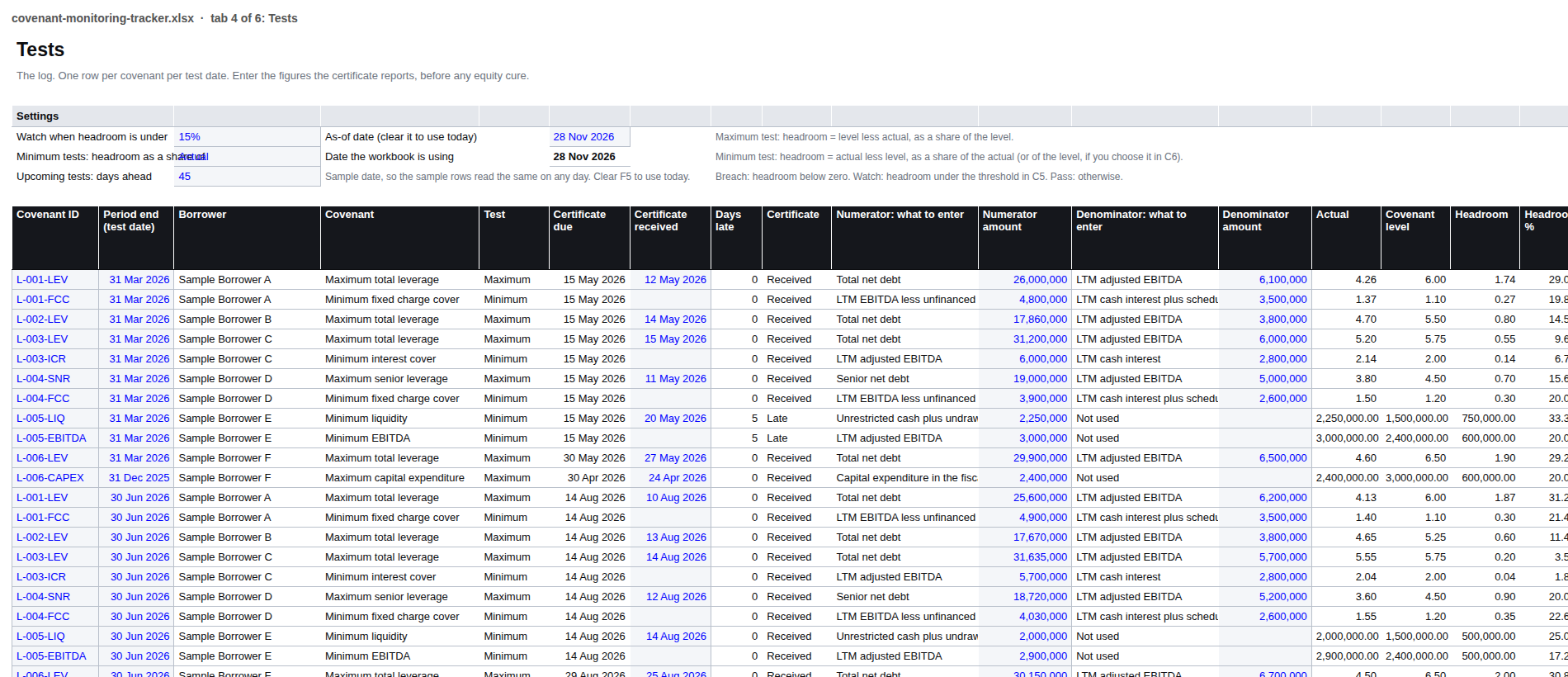
This workbook puts a lender's whole book in one file. Loans is the register. Covenants holds each test, whether it is a maximum or a minimum, and the level at each of the next eight test dates. Tests is the log: enter the two figures from the compliance certificate and it works out the ratio, finds the level for that date, and gives the headroom and the status. The Watch list picks out every loan with a breach, thin headroom, an overdue certificate or headroom that has fallen two tests running. The Quarter summary is the page for the portfolio review.
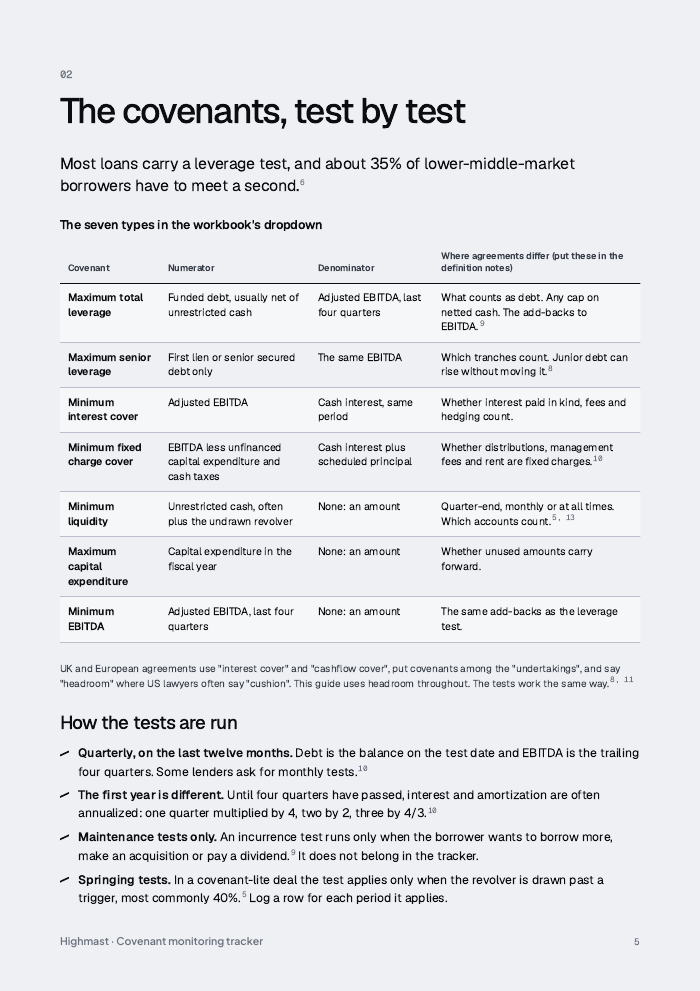
The 11-page guide explains the method. It covers the seven covenants a lower-middle-market lender meets and how each is tested, works a maximum and a minimum test through by hand, and shows how equity cures, step-downs and add-backs change a result. The definitions come from law firms' published guidance and from a direct lender's credit agreement filed with the SEC.34 The six borrowers in the file are fictional samples that show a pass, a watch, a breach with a cure, a step-down, a late certificate and an overdue one.
It is a spreadsheet. It does not read a credit agreement, rebuild adjusted EBITDA or check a borrower's add-backs, and the 15% watch threshold is our starting point for you to change. For where this job sits in a lender's week, read covenant monitoring: where private credit hours hide, or see how it fits the work of private credit funds.
Yes. Use it inside your firm and change it as you like.
It is a plain .xlsx file with no macros and no links to other files. The lookups use INDEX, MATCH, COUNTIFS and SUMIFS, which Excel 2016 and Google Sheets both have. Every formula was evaluated by a formula engine, with the sample data and with it cleared, and the headroom and status cells were confirmed by hand. We have not opened it in every program, so tell us if something misbehaves.
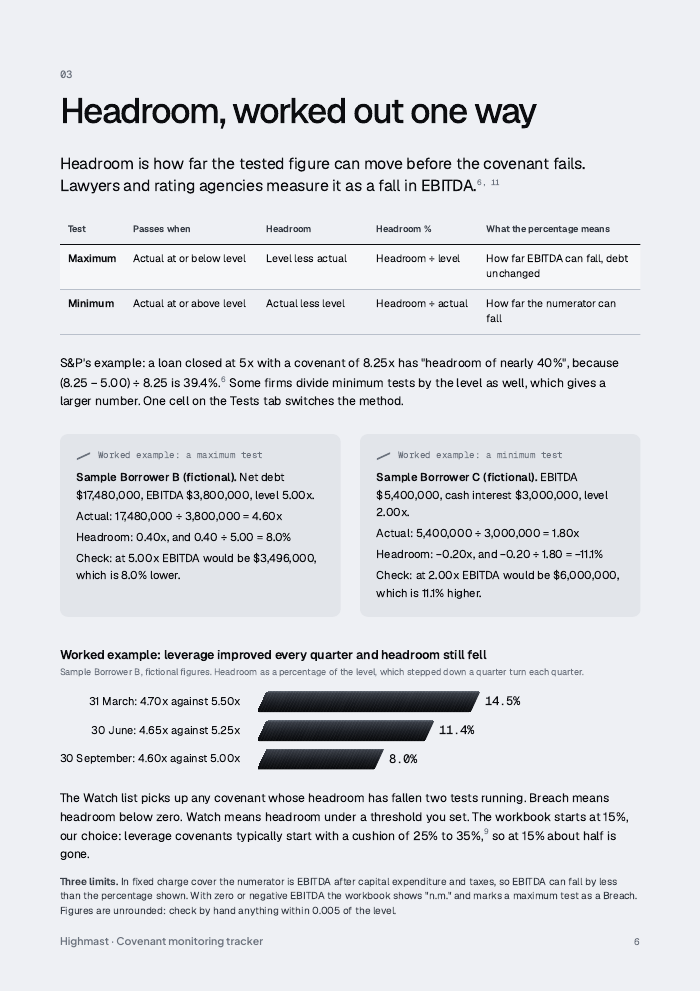
Headroom is the actual less the level, shown as a share of the actual. Cover of 1.80x against a 2.00x floor is headroom of -0.20x, or -11.1%: EBITDA would have to rise 11.1% to pass. For a maximum test the share is taken of the level. Both then mean the fall in EBITDA that would break the test, which is how S&P Global Ratings and the law firms describe headroom.
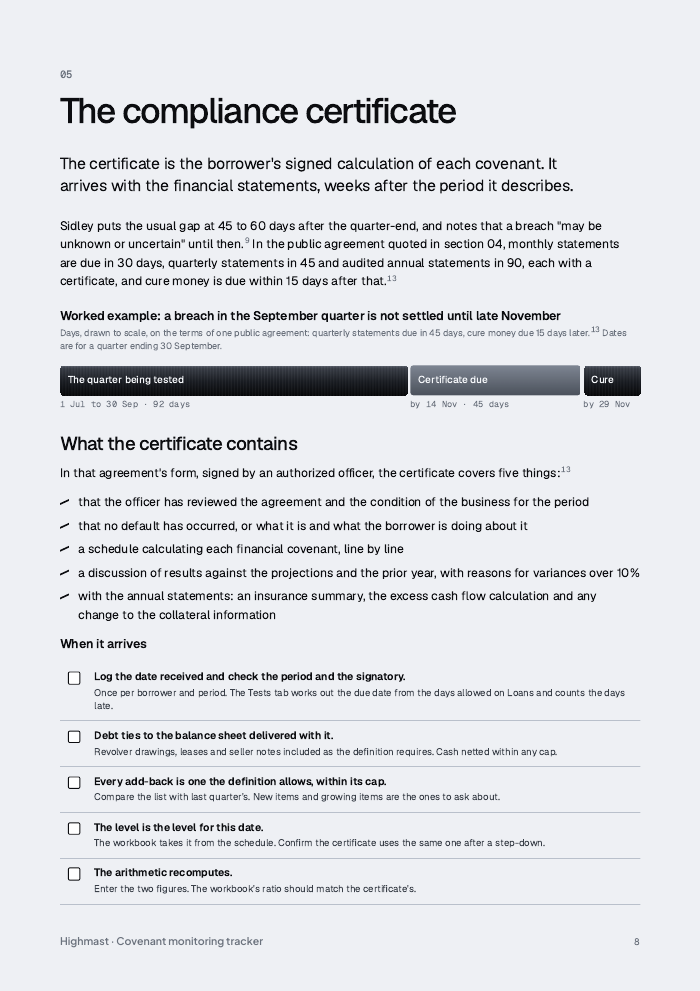
Step-downs, yes: each covenant holds a level for each of its next eight test dates and every test uses the level for its own date. Cures are recorded. They are not modeled. You enter the figures before the cure, mark that one was used, and the workbook counts how many the loan has left.
150 loans, 300 covenants and 600 tests as built, and the test log extends to 2,000 rows by copying the last row down. It is meant for a book of 10 to 60 borrowers. Beyond that the manual entry becomes the weak point.
No. That depends on cure periods, waivers and notice provisions in the credit agreement. The workbook tests the two figures you give it against the level you entered. Nothing in it is legal advice.
Underwriting gets the attention in direct lending. Monitoring grows with every loan in the book. The evidence, and what a single covenant tracker must hold.
Read →
Surveys put AI use in dealmaking anywhere from 21% to 96%. We set 11 studies from 2025 and 2026 side by side and show what each one actually asked.
Read →
What the 2026 surveys and controlled studies measured about wrong numbers in machine-drafted deal documents, and what a reviewer should check and sign.
Read →How many more deals the same team could carry, worked out from your own hours.
Which heavy job to systemise first, ranked from four questions about each.
What the 2026 surveys measured about AI in deal teams, and what they did not.